


From CES to CHPP-1: more heat supply
In the 1960s and 1970s, housing construction in the capital of Kazakhstan proceeded at a rapid pace on an industrial scale. This required the development of utilities, a stable electricity supply, and… centralized heating to reduce the number of small boiler houses operating throughout the city.

Therefore, reconstruction began at the Alma-Ata Central Electric Station (CES): in 1960-1961, as part of the fourth stage of expansion, two high-pressure power boilers and a turbine were installed and commissioned to supply steam to industrial consumers and for water heaters. Soon, the station began to generate thermal energy in addition to electricity. This new function led to the renaming of the CES to Alma-Ata CHPP-1 (Combined Heat and Power Plant №1).
CHPP-1 officially began supplying heat in the fourth quarter of 1961. The use of cogeneration, or the combined production of heat and power, drastically reduced the cost of electricity generation. By many metrics, the plant was among the best in the USSR in the 1950s and 60s. This included its performance in innovation and its fuel consumption rate per unit of energy produced. Memos and reports from CHPP-1 at that time noted that cogeneration sharply decreased fuel costs for electricity generation. For instance, according to reports, in 1963, fuel consumption for electricity supply fell by 150 g/kWh compared to 1961, and by almost 10 times compared to 1936!
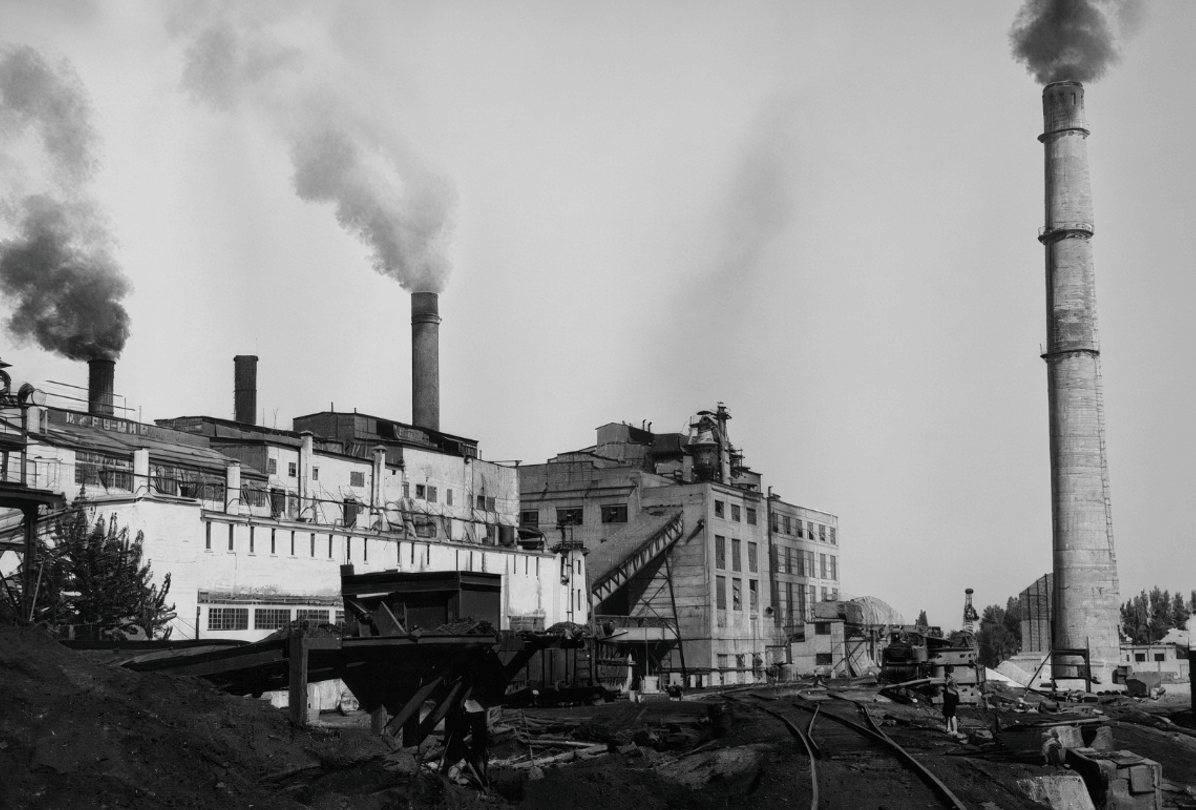
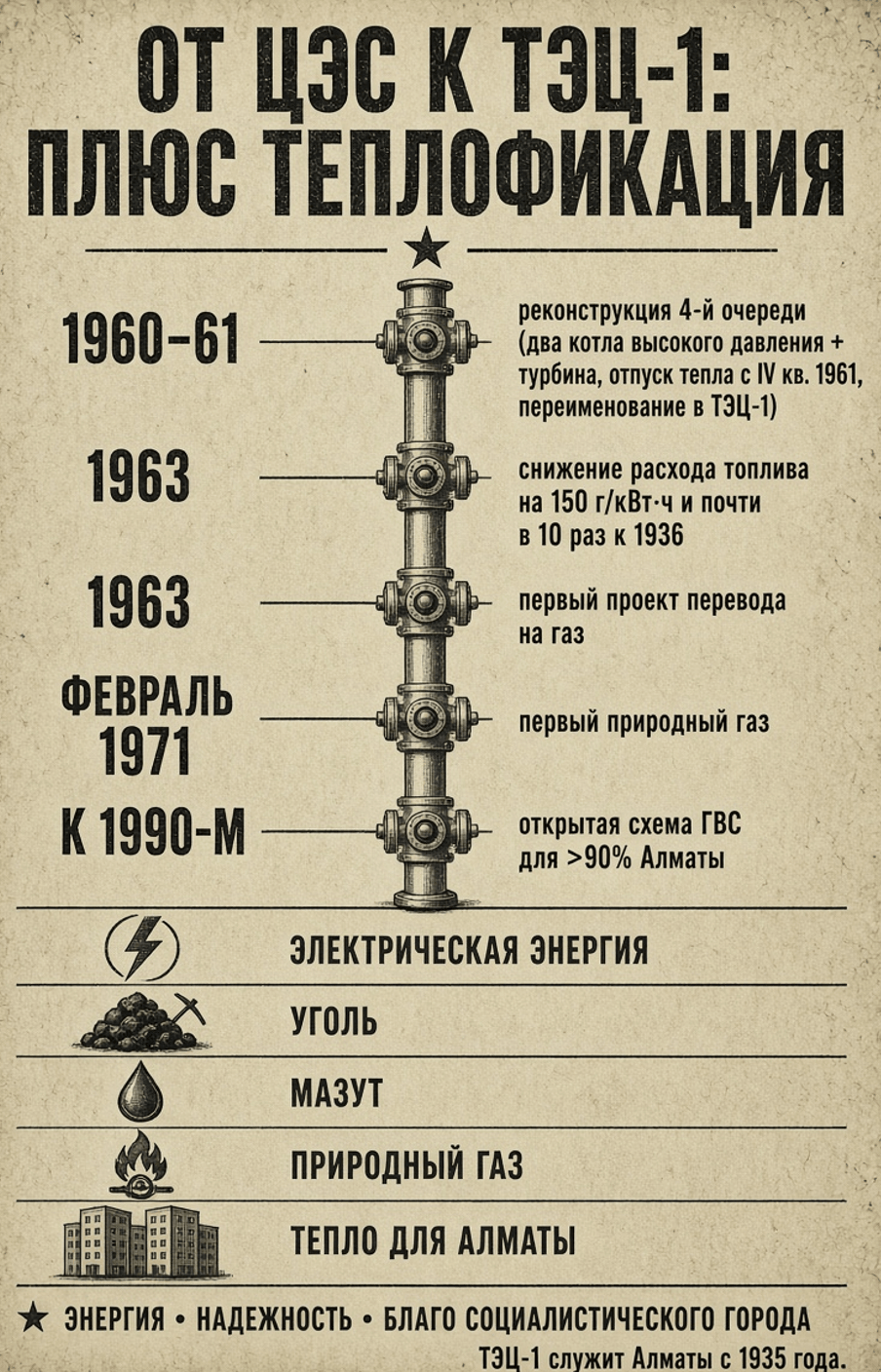 Notably, as early as the 1960s, the topic of environmental protection and the need to convert the plant to cleaner fuel emerged for the first time at both the plant and industry leadership levels. This was partly because the CES, originally built outside the city limits, was now located within the city’s boundaries by the 1960s. Soot and emissions from the CHPP’s boiler houses were polluting the air, and technical solutions were required. The first of these was considered back in 1963. At that time, the Bashorgenergoneft Installation and Commissioning Department of the USSR Ministry of the Oil Industry developed the “Project Assignment for the Transition of the Alma-Ata TPP Boiler to Gas-Shaped Fuel Burning.”
A detailed work schedule for converting the plant to gas was even drawn up. The technical specifications stipulated that natural gas from the Bukhara-Khiva fields would be used as a buffer fuel.
The execution of the detailed design was included in the 1965 Design Work Plan of the USSR State Production Committee for Power and Electrification. This marked the fifth stage of expansion.
The first volume of natural gas was burned at CHPP-1 in February 1971. From that point on, three types of fuel were used. Coal from the Karaganda basin was adopted as the primary fuel for the power boilers, while fuel oil (mazut) was used as a starter fuel and to support the flame when necessary. Gas was used in the power boilers during the off-season, when surplus natural gas was burned. For the water-heating boilers, fuel oil and gas were used as the primary fuels.
It is noteworthy that by the early 1990s, Almaty was one of the few cities in the post-Soviet space where all consumers – residents, municipal institutions, and industry – received hot water from Almatyenergo’s heating networks via an open water intake system. Overall, Almatyenergo provided centralized heating to more than 90% of the population and economy of the cities of Almaty, Kapchagai, and Tekeli, and the settlements of Energetichesky and Ulken.