


19.05.2026 Environmental activity of AlES JSC in 2025
ENVIRONMENTAL PROTECTION. RATIONAL USE OF WATER RESOURCES
JSC “AlES” operational activities are aimed at minimizing environmental impact, rational use of natural resources, and preservation of biodiversity.
JSC “AlES” acknowledges its responsibility to stakeholders for the rational use of natural resources and the preservation of a favorable environment, and guarantees the rational use of natural resources, a consistent reduction in environmental impact through the implementation of new accessible, low-waste, environmentally safe technologies, equipment, and materials, the implementation of climate change adaptation measures, and the prevention of any possible environmental damage.
JSC “AlES” adheres to the principles of sustainable development, which it understands as a balanced and socially acceptable combination of economic growth and the preservation of a favorable environment for future generations.
GREENHOUSE GAS EMISSIONS
 In 2025, JSC “AlES” at CHPP-1, CHPP-2, CHPP-3, and ZTK conducted an inventory of greenhouse gas emissions for the period of validity of the National Plan for the Allocation of Greenhouse Gas Emission Quotas for 2022-2025 (hereinafter – the Plan). According to the Plan, JSC “AlES” was allocated 5 949,562 thousand tons for 2025. Actual emissions of greenhouse gases for 2025, for JSC “AlES” as a whole, amounted to 5 559,096 thousand tons, of which: at CHPP-1 named after B.Orazbayev: 475,285 thousand tons; at CHPP-2 named after A.Zhakupov: 3 694,452 thousand tons, at CHPP-3: 1 170,772 thousand tons, at ZTK: 218,587 thousand tons.
Volume of Greenhouse Gas Emissions in 2022-2025 (Scope 1)
| Greenhouse gas emissions by type | Units of measurement |
2022 | 2023 | 2024 | 2025 |
| СО2 | tons of СО2 | 5 675 899 | 5 787 876 | 5 619 013 | 5 559 096 |
| СН4 | tonnes CO2eq | 1 200,2 | 1 389,9 | 1 345,876 | 1 349,379 |
| N2O | tonnes CO2eq | 14 692,6 | 12 929,6 | 12 535,0 | 12 539,641 |
| Specific greenhouse gas emissions relative to revenue | million tonnes CO2 eq/million tenge |
0,00007 | 0,00006 | 0,00004 | 0,000058 |

The expected quota surplus relative to the carbon quota Plan will amount to 90,466 thousand tons. In 2025, through the implementation of energy conservation and energy efficiency improvement measures, the total volume of greenhouse gas emissions was reduced by 24,5 thousand tons.
Greenhouse gas emission volumes for 2025 were verified by the validation and verification body LLP “ECOSERVICE-S”; the greenhouse gas inventory report was submitted to the authorized environmental protection authority within the established deadlines and accepted without comments.
According to the Action Plan for Environmental Protection Management within the “Samruk-Energy” JSC group of companies, JSC “AlES” determined the quantities of emissions of such greenhouse gases as hydrofluorocarbons (HFCs), perfluorocarbons (PFCs), sulfur hexafluoride (SF6), and nitrogen trifluoride (NF3).
| Greenhouse gas emissions by type |
Units of measurement |
2023 | 2024 | 2025 |
| HFCs | tons | 116,2 | 133,9 | 262,1 |
| ПФУ | tons | not available | not available | not available |
| SF6 | tons | not available | not available | not available |
| NF3 | tons | not available | not available | not available |
Within Scope 2, emissions from the generation of purchased and consumed electricity, steam, heat, or cooling are subject to quantitative assessment. As JSC “AlES” does not purchase electricity or thermal energy, steam, the volume of greenhouse gas emissions is not calculated.
Within Scope 3, JSC “AlES” considered the boundaries of the system under study, within which calculations of indirect greenhouse gas emissions (CO₂-equivalent) were performed. The “cradle-to-grave” principle has been adopted as the methodological approach. The base year for calculating indirect greenhouse gas emissions (Scope 3) is 2024. JSC “AlES” plans to account for indirect greenhouse gas emissions (Scope 3) on an annual basis.
The system boundaries encompass the entire life cycle of products and services: from raw material extraction (including coal), production, transportation, use, to final product disposal. Calculations included only indirect emissions arising from JSC “AlES” activities but occurring outside its direct operational control.
Scope 3 indirect emissions are divided into 15 different Categories. This division is made for greater convenience in accounting for all possible greenhouse gas emissions. These 15 categories are also divided into two types of supply chain flows: upstream and downstream flows, respectively (Upstream emissions and Downstream emissions).
Upstream flows include emissions from raw materials, goods, and services purchased by the organization, excluding those emissions accounted for in Scope 1 and 2. These emissions are generated off-site during the creation of purchased products. Downstream flows, accordingly, include those emissions that arise outside of JSC “AlES” production departments from the use and end-of-life of products manufactured by it.
Calculations for JSC “AlES” were performed for the following categories: 1 – Purchased goods and services; 2 – Purchased capital goods; 4 – Upstream transportation and distribution of raw materials and purchased goods; 5 – Waste generated in operations; 6 – Business travel; 7 – Employee commuting.
The remaining categories were not applicable due to the specific nature of the production activities.
Thus, within the study boundaries, Scope 3 greenhouse gas emissions were not assessed for the following categories: 3 – Other indirect energy-related emissions – Transmission and distribution losses, 8 – Leased assets, Category 9 – Transportation and distribution of sold products, 10 – Transportation and distribution of sold products, Category 11 – Use of sold products, 12 – Disposal of sold products, 13 – Assets leased out, 14 – Franchises, 15 – Investments.
Category 3 – Other indirect energy-related emissions – Transmission and distribution losses – is excluded because emissions from consumed fuel and energy are already accounted for in Scope 1 and Scope 2. JSC “AlES” does not have additional types of energy or fuel purchased as services (e.g., centralized heat supply).
Category 8 – Leased assets – most production facilities and vehicles are owned or on the balance sheet of JSC “AlES” production departments. The use of rented equipment is minimal and does not make a significant contribution to the total emission volume.
Category 8 is excluded from calculation, as:
– the company does not utilize leased assets located outside its operational control;
– all main production and auxiliary assets, including equipment, buildings, and machinery, are owned by the organization or fully controlled by it;
– leased assets (if any) are included in Scope 1 and 2, if under operational control, in accordance with the GHG Protocol approach.
Due to the absence of relevant emission sources, Category 8 is deemed inapplicable to the activities of the production departments of JSC “AlES” and has been excluded from the Scope 3 calculation.
Category 9 – Transportation and distribution of products:
This category is not applicable, as:
– The product (electricity) is transmitted to the grid, and further distribution is carried out by independent grid operators not affiliated with the company.
– The physical transportation of electricity does not require the use of transport in the traditional sense (such as the transportation of goods by road or rail).
– JSC “AlES” does not control or organize the logistics or distribution of electricity to the end consumer.
Category 9 Scope 3 is not applicable to JSC “AlES” as there is no transportation or logistical activity for product distribution carried out by the production departments.
Category 10 – Transportation and delivery of sold products – is not applicable.
The category includes indirect emissions arising from the subsequent processing or transformation of products sold by the organization prior to their final use.
The enterprise’s products – electricity and coal – are not subject to further physical processing or modification after sale. Electricity and coal are used directly by end consumers (households, businesses, organizations) without further processing.
Consequently, there is no process generating emissions as a result of the processing or transformation of sold products.
Category 11 – Use of sold products – is excluded.
The category covers greenhouse gas emissions arising from the end consumer’s use of products sold by the company, if this use process causes emissions.
This category is not applicable, as:
– The primary product – electricity – is used by a wide range of consumers across various sectors (residential, industrial, services).
– Control over how electricity is used is absent – JSC “AlES” does not determine the method or efficiency of its end-use.
According to the methodological recommendations of the GHG Protocol, the use of energy supplied to the grid is generally not accounted for in Category 11 for energy generators, but is attributed to Scope 2 at the consumer.
Scope 3 Category 11 does not apply to JSC “AlES” as it does not control or determine the nature of the use of electricity sold by final consumers.
Category 12 – Disposal of Sold Products. This category covers emissions associated with the disposal or recycling of sold products after their end-of-life.
The primary products of JSC “AlES” are electrical and thermal energy, which are consumed directly and do not generate physical waste after use. Electricity, as a form of energy, does not have a residual material product subject to disposal or recycling. Coal does not have residual mass or components requiring disposal, unlike durable goods.
The activities of JSC “AlES” do not involve processes of waste disposal or management that could cause additional greenhouse gas emissions.
Category 13 – Leased Assets.
This category covers emissions associated with the use of leased assets that are not owned by the company but are used by it in its operational activities. JSC “AlES” does not lease assets outside its operational control that could generate greenhouse gas emissions within the downstream value chain. This category is not applicable.
Category 14 – Franchises.
This category covers greenhouse gas emissions arising from the activities of organizations operating under a franchise of the reporting company’s brand, but not part of its direct ownership or operational control.
JSC “AlES” does not utilize a franchising model in its operations.
Category 15 – Investments – under Scope 3, covers greenhouse gas emissions arising from the company’s investment or lending activities. These emissions are indirect and are associated with the activities of third-party organizations in which funds are invested. JSC “AlES” is a subsidiary of JSC “Samruk-Energy” and does not conduct independent investment or lending activities; Category 15 is not applicable.
The calculation of total Scope 3 emissions is shown in the table below.
Table 7.8 – Total GHG Emissions for Scope 3 by Category for JSC “Almaty Electric Stations”
| Categories | Scope 3 Emissions tCO2eq. |
| Category 1 | 18 156, 572 |
| Category 2 | 3 873,314 |
| Category 4 | 59 888,460 |
| Category 5 | 6 948,430 |
| Category 6 | 166,048 |
| Category 7 | 559,577 |
| Total | 89 592,401 |
Thus, total Scope 3 greenhouse gas emissions amounted to 89,592.401 tCO2 eq .
Based on the table, the significance of each emission category can be calculated as a percentage of the total emissions of JSC “AlES”.
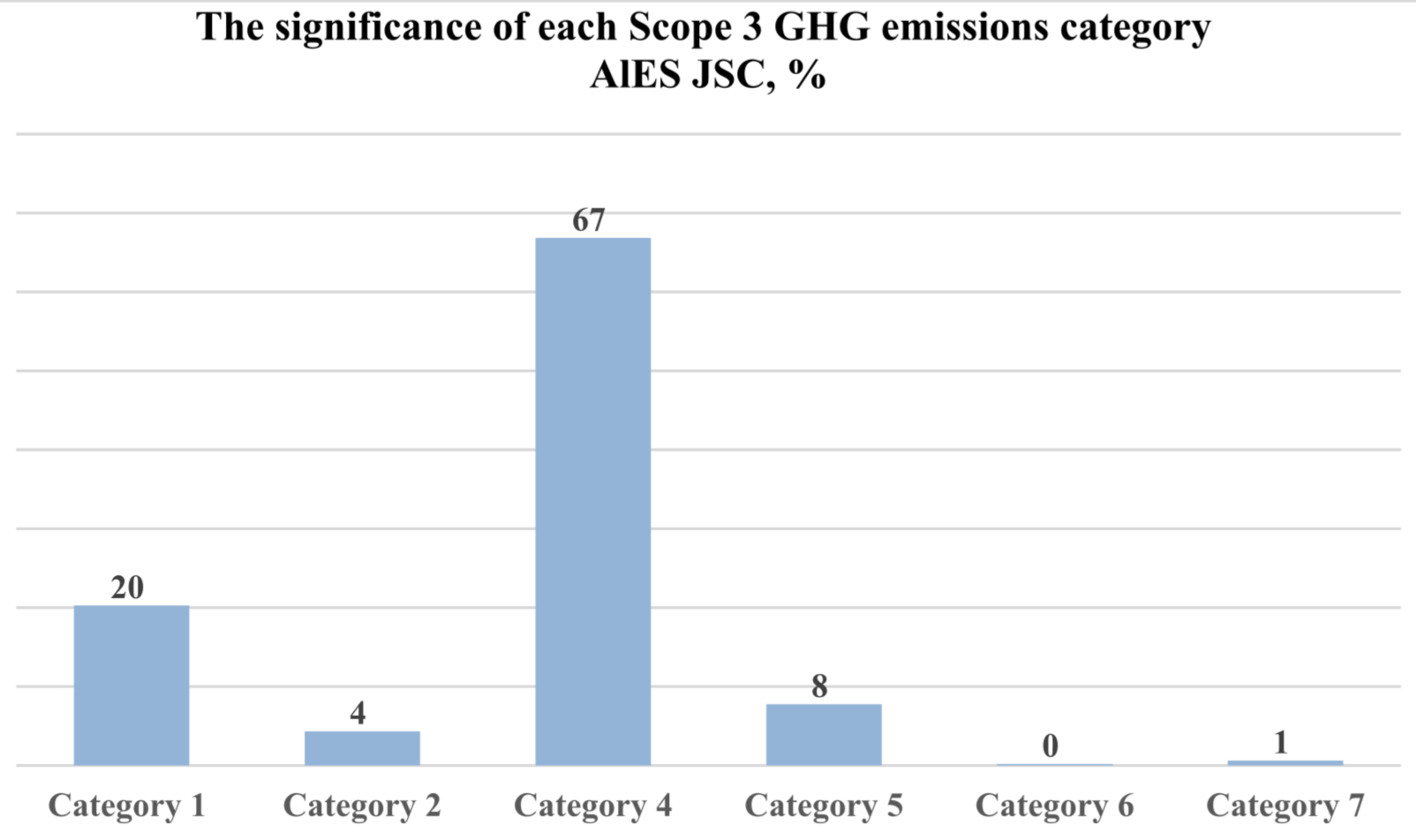
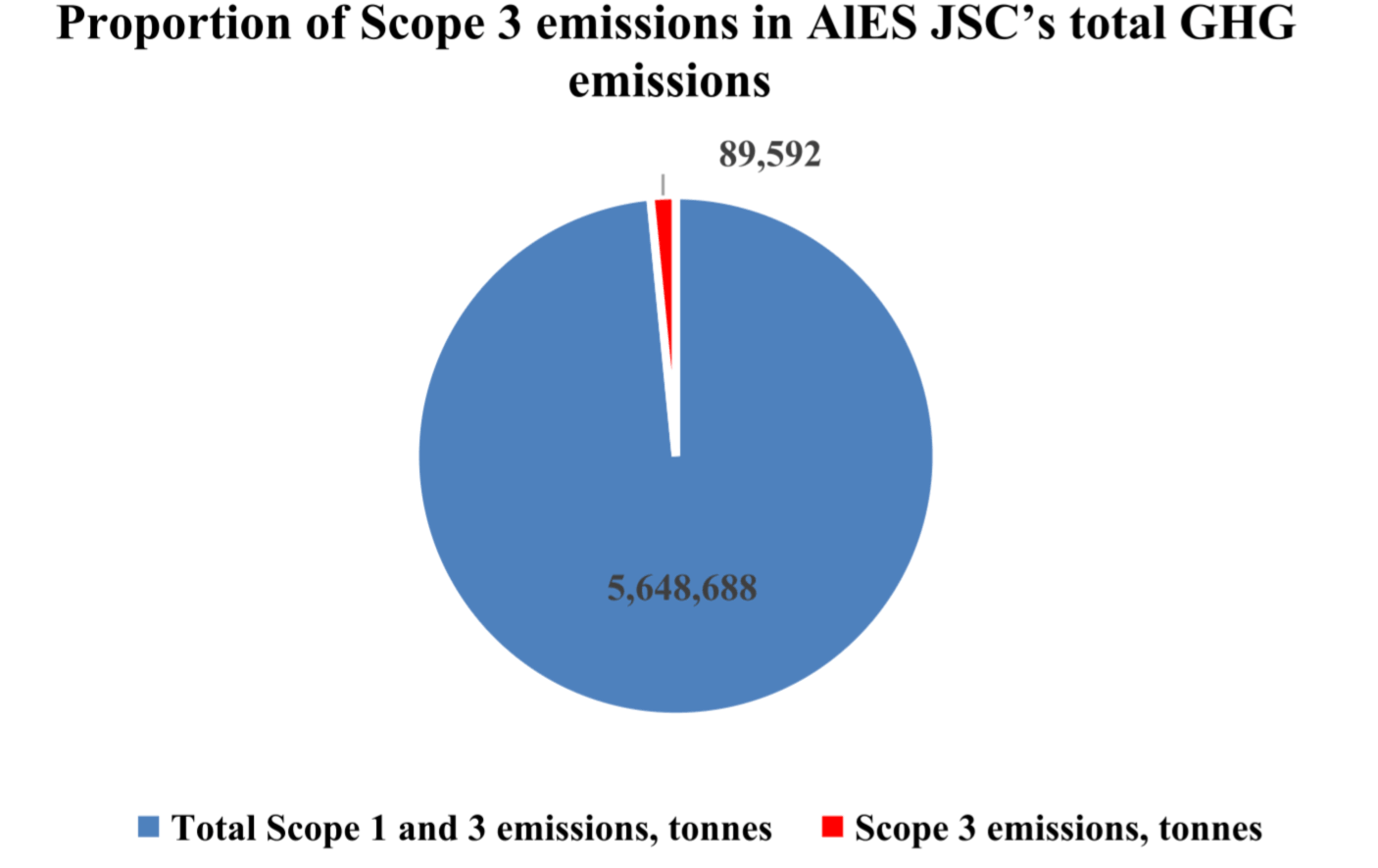
Based on the analysis of the indicators, it can be concluded that in percentage terms, the share of greenhouse gas emissions under Scope 3 in the total GHG emissions of JSC “AlES” is 1.6%.
Below is a diagram “Ratio of Scope 3 Emissions to Total GHG Emissions for JSC “AlES”.
Carbon Intensity of Generation
The assessment of JSC “AlES’s” carbon intensity indicators was performed by comparing direct greenhouse gas emissions (Scope 1) for 2025 with the average industry indicators for the electricity sector of the Republic of Kazakhstan.
This approach complies with international climate disclosure standards, including IFRS S2 Climate-related Disclosures and the GHG Protocol Corporate Standard.
According to IFRS S2 and GHG Protocol, Scope 1 emissions represent direct greenhouse gas emissions from sources controlled by AO “AlES”, including fuel combustion in boiler units.
For electric power industry enterprises, the primary indicator of carbon intensity is the ratio of CO₂-equivalent emissions volume to generated electricity and heat energy, or to the company’s financial result. IFRS S2 recommends the use of SASB/ISSB industry metrics for the Electric Utilities & Power Generators sector.
Within the scope of AO “AlES” assessment, the following carbon intensity formula was used:
Per unit of generated electrical energy:
CI=Scope 1 emissions (tCO2e)/Electricity generation (MWh), where:
CI – carbon intensity indicator;
Scope 1 emissions – direct greenhouse gas emissions, t CO₂-eq.;
Electricity generation – volume of produced electricity, MWh.
Per unit of generated thermal energy:
CI heat=Scope 1 emissions (tCO2e)/Heat generation (Gcal)
Scope 1 emissions – direct greenhouse gas emissions, t CO₂-eq.;
Heat generation – volume of produced heat energy, Gcal.
For the assessment of AO “AlES” carbon intensity, its Scope 1 metrics were compared with the largest energy companies in Kazakhstan: Samruk-Energy and KEGOC.
Such comparative analysis complies with the requirements of international standards IFRS S2 and GHG Protocol for industry benchmarking of climate indicators.
⇒ per unit of generated electrical energy:
| Company | Principal activity | Generation type | Estimated carbon intensity | Characteristic |
| JSC “AlES” | Almaty Electricity and Heat Supply | Coal + partial gas | 0.9–1.0 t CO₂-e/MWh | High carbon intensity |
| EGRES-1 | Coal-fired generation | Coal | 1.0–1.2 t CO₂-e/MWh | Very high |
| EGRES-2 | Coal-fired generation | Coal | 0.9–1.1 t CO₂-e/MWh | High |
| JSC Samruk-Energo | Electricity generation | Primarily coal | 0.8–1.0 t CO₂-e/MWh | Above industry average |
| KEGOC | Electricity transmission | Network infrastructure | <0,05 t CO₂-e/MWh | Low carbon intensity |
⇒ per unit of generated thermal energy:
| Company | Principal activity | Generation type | Estimated carbon intensity | Characteristic |
| JSC “AlES” | Electricity and heat supply for Almaty | Coal and partially gas |
Coal – 0,45–0,55 t CO₂-e/Gcal Gas – 0,18–0,25 t CO₂-e/Gcal | High carbon intensity |
| EGRES-1 | Coal generation | Coal | 0,45–0,55 t CO₂-e/Gcal | Very high |
| Gas-fired CHP plants of Kazakhstan |
Gas Generation | Gas | 0.18–0.30 t CO₂-e/Gcal | Below average |
| JSC Samruk-Energo | Electricity Generation | Predominantly Coal | 0.35–0.50 t CO₂-e/Gcal | Above industry average |
Within the scope of Scope 1, the carbon intensity of AO “AlES” generation was calculated for 2025 in comparison with previous periods of 2022-2024. The volume of greenhouse gas emissions directly depends on the volume of fuel burned and fuel characteristics.
| № Ite m |
Indicator | Unit of Measurement |
2022 | 2023 | 2024 | 2025 |
| 1 | СО2 emissions | tonnes | 5 675 899 | 5 787 877 | 5 619 013 | 5 559 096 |
| 2 | Generation of Electrical Energy | MWh | 4 039 025 | 3 954 773 | 3 723 258 | 3 830 134 |
| 3 | Generation of Thermal Energy | Gcal | 5 550 462 | 5 851 848 | 6 083 619 | 5 920 172 |
| 4 | Specific CO2 Emissions per Electricity Generation | tCO2/MWh | 0,988 | 1,001 | 1,002 | 0,972 |
| 5 | Specific CO2 emissions per unit of thermal energy generation |
tCO2/Gcal | 0,304 | 0,312 | 0,310 | 0,310 |
Energy Transition Program and Greenhouse Gas Emissions Reduction
AO “AlES” has assumed obligations for the reduction of greenhouse gas emissions. For these purposes, AO “AlES” has developed an Energy Transition Program for the period from 2026 to 2060.
The Program scenarios have determined the following targets for GHG emissions reduction:
✓ Short-term (baseline) (2025-2030) – defined for a five-year period within the framework of the Corporate Environmental and Energy Goals of JSC “Samruk-Energy” and JSC “AlES”.
↓ reduction of CO2 emissions by 20-30%
↓ reduction of coal share to ‹60% development/modernization/construction of Hydroelectric Power Plants.
✓ Medium-term (decarbonization) (2030-2040) – defined for a ten-year period within the framework of the long-term corporate environmental and energy goals of JSC “Samruk-Energy” and JSC “AlES”.
– decommissioning of coal-fired power plants;
– development of new sources operating on gas fuel, commissioning of new capacities at Hydroelectric Power Plants.
✓ Long-term (deep decarbonization) (2041-2060) – defined within the framework of the long-term environmental and energy goals of the Republic of Kazakhstan to achieve a balance between anthropogenic GHG emissions and their absorption by 2060.
– carbon neutrality
– 70-80% of generation — clean energy.
Due to the significance of global trends in limiting climate change and the risks associated with production activities based on traditional generation, JSC “AlES”, as a subsidiary organization of JSC “Samruk-Energy”, will minimize its negative impact on the environment by reducing its carbon footprint by 2060.
EMISSIONS OF POLLUTANTS
 JSC “AlES” has undertaken obligations to reduce emissions of pollutants into the atmosphere during the production of products by its production departments. For emission reduction in 2025, the following environmental protection measures were implemented:
– work was carried out to maintain the efficiency of ash removal devices;
– repair and replacement of air heater cubes;
– repair of boiler unit burners, emulsifiers;
– measures were implemented to increase efficiency;
– violations in the technological cycle on boiler units were eliminated;
– commissioning and adjustment works were carried out on boiler units, dust extraction systems of CHP-1, 2, 3.
Also, in 2025, JSC “AlES” continued work on the implementation of modernization and reconstruction projects for Almaty CHPP-2 and CHPP-3. Following the implementation of these projects, the reduction will be achieved through the use of natural gas in efficient gas turbine units, ensuring emissions of harmful substances into the atmosphere at the level of the Republic of Kazakhstan’s requirements for the implementation of Best Available Techniques.
Volume of pollutant emissions for the period 2022-2025, thousand tons
| Polluting substances | 2022 | 2023 | 2024 | 2025 |
| NОx | 11,078 | 11,286 | 10,963 | 10,363 |
| SOx | 22,557 | 25,820 | 25,086 | 25,352 |
| Particulate Matter | 8,212 | 8,614 | 8,349 | 8,489 |
| СО | 3,115 | 3,095 | 3,019 | 2,993 |
| Volatile Organic Compounds (VOCs) | 0,032 | 0,035 | 0,050 | 0,111 |
| Other gaseous substances | 0,044 | 0,011 | 0,036 | 0,169 |
| Total | 48,038 | 48,861 | 47,503 | 47,477 |
| Persistent organic pollutants (POPs) | none | none | none | none |
| Hazardous air pollutants (HAPs) | 48,038 | 48,861 | 47,503 | 47,477 |
| Specific emissions, g/kWh | 8,63 | 8,74 | 8,81 | 8,7 |
| Specific emissions of hazardous substances per unit of revenue | 0,00056 | 0,00051 | 0,00038 | 0,00037 |

The actual volume of emissions for AO “AlES” in aggregate in 2025 decreased by 0.1% compared to 2024 and amounted to 47.477 thousand tons, against an authorized volume of 54.424 thousand tons. For comparison, in 2024 it was 47.503 thousand tons, against an authorized volume of 56.153 thousand tons, and in 2023 it was 48.861 thousand tons, against an authorized volume of 57.065 thousand tons.
CHPP-1

Atmospheric emissions of pollutants in 2025 amounted to 783.795 tons (including fugitive emissions), against an authorized limit of 1,436.466 tons. Gross atmospheric emissions of pollutants in the reporting year decreased by 52.205 tons (-6%), as fuel oil was not combusted in 2025, whereas in 2024, 5,802 tons of fuel oil were combusted.
CHPP-2

Atmospheric emissions of pollutants in 2025 amounted to 36,548.334 tons (including fugitive emissions), against an authorized limit of 37,581.169 tons. Gross atmospheric emissions of pollutants in the reporting year increased by 360 tons (+0.9%), which is attributable to a 4% increase in electricity generation in 2025 compared to 2024.
CHPP-3

Atmospheric emissions of pollutants from the CHP-3 department in 2025 amounted to 9,780.602 tons (including fugitive emissions), against an authorized limit of 13,965.162 tons. Gross atmospheric emissions of pollutants in the reporting year decreased by 473 tons (-5%), which is attributable to an 8% decrease in electricity generation in 2025 compared to 2024.
ZTK

2025 amounted to 214.709 tons, against an authorized limit of 1,288.936 tons. Gross atmospheric emissions of pollutants in the reporting year decreased by 1.5 tons (-0.8%), which is attributable to a decrease in thermal energy generation in 2025 compared to 2024.
Kapshagay HPS

Atmospheric emissions of pollutants from Kapschagayskaya HPP in 2025 amounted to 1.258 tons, against an authorized limit of 1.258 tons; discharges of pollutants into surface waters from Kapschagayskaya HPP in 2025 were 1.5791 tons, against an authorized limit of 1.64898 tons.

The volume of discharges increased by 0.02306 tons, which is attributable to an increase in the discharge volume of normatively treated domestic sewage (water outlet No.3) at Kapschagayskaya HPP.
HPP Cascade

Atmospheric emissions of pollutants from the HPP Cascade in 2025 amounted to 1.5258 tons and did not exceed the emission limit of 2.679 tons.
PRP “Energoremont”

Atmospheric emissions of pollutants from PRP «Energoremont» in 2025 amounted to 6.79995 tons. The limit for gross atmospheric emissions of pollutants in the reporting year was not exceeded.
WATER RESOURCES
 The main source of water supply for the departments of AO «AlES» CHP-1, CHP-2 and ZTK is the State Communal Enterprise on the Right of Economic Management «Almaty Su» of the Department of Energy and Water Supply of the city of Almaty (hereinafter referred to as «Almaty Su»).
Water supply to CHP-1 is carried out from the «Almaty Su» pumping station via two 1000 mm diameter pressure pipelines. Water supply to CHP-2 is carried out from pumping station No.29 of the Talgar underground water intake of «Almaty Su» via two 700 mm diameter pipelines and two 800 mm diameter pipelines.
For partial substitution of raw water supplied to CHPP-1 for technological purposes and to CHPP-2 for the preparation of demineralized water, wells of the own water intake are utilized, and pursuant to an agreement, the abstraction of technical water is carried out for CHPP-2.
Domestic and drinking, as well as industrial and technical water supply to CHPP-3 is provided by a departmental water intake from artesian wells. The water intake of CHPP-3 consists of one single production well and five water intake clusters, each comprising two production wells. The depth of the production wells ranges from 200 to 300 m. In 2025, 11 wells were in operation.
For the Cascade of HPPs, the water source for power generation needs is Big Almaty Lake and the basin of the Bolshaya Almatinka River. Domestic and drinking water supply for the Cascade of HPPs is provided under contract.
For electricity generation and technological purposes of Kapshagay HPP, water abstraction is performed from Kapshagay Reservoir; for domestic and sanitary needs, water abstraction is performed from underground wells of the Nikolaevskoye underground water field.
Calculation of water consumption and wastewater discharge for the departments of JSC “ALES” CHPP-1, CHPP-2, CHPP-3, and ZTK is performed in accordance with the Individual current balance norms for water consumption and wastewater discharge, approved by the Committee on Water Resources of the Ministry of Ecology, Geology and Natural Resources of the RK. Water abstraction volumes from surface sources of Kapshagay HPP, Cascade of HPPs, and the own water intake of CHPP-1, CHPP-2, and CHPP-3 are determined by the terms of the permit for special water use.
Below, the tables present data on water consumption and water utilization for the years 2022-2025.
Analysis of water consumption and water utilization by sources of JSC “ALES”, in m3
| Indicators | CHPP-1 | CHPP-2 | CHPP-3 | ZTK | Kapshagay Hydroelectric Power Station | Hydroelectric Power Plant Cascade | ||||||
| 2022 | 2023 | 2022 | 2023 | 2022 | 2023 | 2022 | 2023 | 2022 | 2023 | 2022 | 2023 | |
| Sources of Water Supply | State Communal Enterprise on the Right of Economic Management “Almaty Su”, Own Water Intake Facility of the Almaty Main Water Pipeline | State Communal Enterprise on the Right of Economic Management “Almaty Su”, Own Water Intake Facility of the Boraldai Main Water Pipeline |
Own Water Intake Facility of the Pokrovskoye Main Water Pipeline | State Communal Enterprise on the Right of Economic Management “Almaty Su” |
Kapshagay Reservoir, Wells of Own Water Intake | Limited Liability Company “Bauyr LTD Company” State Communal Enterprise on the Right of Economic Management “Almaty Su” | ||||||
| Raw Water Received | 6 097 567 | 6 715 791 | 33 343 439 | 33 241 179 | 5 645 610 | 4 961 400 | 34 309 | 42 330 | 7 402 692 | 7 462 429 | 594 | 426 |
| Own Water Intake | 404 243 | 370 069 | 472 170 | 366 850 | 5 645 610 | 4 961 400 | – | – | 5 351 | 5 288 | – | – |
| Expenditure | 6 097 567 | 6 715 791 | 33 343 439 | 33 241 179 | 5 645 610 | 4 961 400 | 34 309 | 42 330 | 7 402 692 | 7 462 429 | 594 | 426 |
| Makeup water for heating network | 5 201 086 | 5 768 279 | 25 285 479 | 24 577 015 | 159 840 | 178 484 | – | – | – | – | – | – |
| Transferred to consumers without utilize | 5 196 077 | 5 763 120 | 25 112 013 | 24 340 386 | 138 002 | 147 725 | – | – | – | – | – | – |
| Production needs | – | – | 127 844 | 192 192 | – | – | – | – | – | – | – | – |
| Own require-ments for hot water supply | 4 473 | 4 935 | 42 187 | 42 692 | 7 746 | 7 746 | – | – | – | – | – | – |
| Transferred to other consumers | 536 | 224 | 3 435 | 1 745 | 14 092 | 23 013 | – | – | – | – | – | – |
| Demineralized water | 184 679 | 191 000 | 969 488 | 1 105 423 | 335 093 | 371 221 | 23 161 | 24 861 | – | – | – | – |
| Boiler make-up | 184 679 | 191 000 | 752 492 | 791 939 | 335 093 | 371 221 | 23 161 | 24 861 | – | – | – | – |
| Non-return of Condensate | – | – | 6 971 | 6 971 | – | – | 70 | 120 | – | – | – | – |
| Internal Requirements of the Auxiliary Installation | – | – | 210 025 | – | – | – | – | – | – | – | – | – |
| Process Water | 673 944 | 719 222 | 7 052 535 | 7 522 374 | 5 138 353 | 4 396 179 | 2 626 | 3 509 | 7 357 009 | 7 417 958 | – | – |
| Losses | – | – | – | – | – | – | 1 420 | 4 864 | 40 332 | 39 183 | – | – |
| Potable water | 37 858 | 37 291 | 35 937 | 36 367 | 12 324 | 15 516 | 7 102 | 9 096 | 5 351 | 5 288 | 594 | 426 |
| Transferred to other consumers | 133 | 293 | 521 | 1 091 | – | – | 1 904 | 2 143 | – | – | – | – |
| Sewerage | 342 727 | 361 039 | 78 124 | 79 059 | 23 095 | 22 656 | 22 460 | 26 821 | – | – | 594 | 426 |
| Own Sewerage | 342 169 | 360 581 | 77 256 | 77 547 | 23 095 | 22 656 | 19 854 | 24 146 | – | – | 594 | 426 |
Analysis of water consumption and water utilization by sources of JSC “ALES”, in m3
| Indicators | CHPP-1 | CHPP-2 | CHPP-3 | ZTK | Kapshagay Hydroelectric Power Station | Hydroelectric Power Plant Cascade | ||||||
| 2024 | 2025 | 2024 | 2025 | 2024 | 2025 | 2024 | 2025 | 2024 | 2025 | 2024 | 2025 | |
| Sources of Water Supply | State Communal Enterprise on the Right of Economic Management “Almaty Su”, Own Water Intake Facility of the Almaty Main Water Pipeline | State Communal Enterprise on the Right of Economic Management “Almaty Su”, Own Water Intake Facility of the Boraldai Main Water Pipeline |
Own Water Intake Facility of the Pokrovskoye Main Water Pipeline | State Communal Enterprise on the Right of Economic Management “Almaty Su” |
Kapshagay Reservoir, Wells of Own Water Intake | Limited Liability Company “Bauyr LTD Company” State Communal Enterprise on the Right of Economic Management “Almaty Su” | ||||||
| Raw Water Received | 5 990 376 | 6 106 984 | 36 015 423 | 33 546 830 | 5 235 050 | 5 539 400 | 45 196 | 38 546 | 9 556 800 | 8 912 785 | 633 | 293 |
| Own Water Intake | 411 916 | 311 235 | 255 180 | 325 770 | 5 235 050 | 5 539 400 | – | – | 5 400 | 5 483 | – | – |
| Expenditure | 5 990 376 | 6 106 984 | 36 015 423 | 33 546 830 | 5 235 050 | 5 539 400 | 45 196 | 38 546 | 9 556 800 | 8 912 785 | 633 | 293 |
| Makeup water for heating network | 5 010 910 | 5 283 409 | 25 648 861 | 26 596 540 | 218 414 | 274 357 | – | – | – | – | – | – |
| Transferred to consumers without utilize | 5 005 839 | 5 278 607 | 25 593 772 | 26 413 396 | 190 267 | 247 239 | – | – | – | – | – | – |
| Production needs | – | – | 15 321 | 136 573 | – | – | – | – | – | – | – | – |
| Own require-ments for hot water supply | 4 557 | 4 428 | 36 389 | 42 111 | 7 746 | 7 746 | – | – | – | – | – | – |
| Transferred to other consumers | 514 | 374 | 3 379 | 4 460 | 20 401 | 19 372 | – | – | – | – | – | – |
| Demineralized water | 192 864 | 207 090 | 1 127 588 | 1 144 804 | 395 745 | 347 876 | 28 706 | 25 108 | – | – | – | – |
| Boiler make-up | 192 864 | 207 090 | 715 997 | 695 077 | 395 745 | 347 876 | 28 706 | 25 108 | – | – | – | – |
| Non-return of Condensate | – | – | 6 837 | 6 971 | – | – | 166 | 160 | – | – | – | – |
| Own require-ments of the auxiliary installation | – | – | 404 754 | 442 756 | – | – | – | – | – | – | – | – |
| Process Water | 751 189 | 585 587 | 9 207 974 | 5 769 612 | 4 599 969 | 4 897 993 | 4 264 | 2 800 | 9 508 987 | 8 868 937 | – | – |
| Losses | – | – | – | – | – | – | 3 721 | 2 751 | 42 413 | 38 365 | – | – |
| Potable water | 35 412 | 30 898 | 31 000 | 35 874 | 20 922 | 19 174 | 8 505 | 8 430 | 5 400 | 5 483 | 633 | 293 |
| Transferred to other consumers | 237 | 39 | 1 258 | 2 163 | – | – | 2 100 | 1 739 | – | – | – | – |
| Sewerage | 220 861 | 64 188 | 67 389 | 77 984 | 15 601 | 29 659 | 24 774 | 20 480 | – | – | 645 | 299 |
| Private sewerage system | 220 390 | 64 088 | 65 541 | 74 768 | 15 601 | 29 659 | 22 217 | 18 393 | – | – | 645 | 299 |
The change in the actual water balance for the departments of JSC “ALES” is mainly dependent on the volume of product output and the actual operating conditions of equipment (number of start-ups, shutdowns of boiler units, mode of ash dump filling with water, repair work on pipelines, etc.). Raw water consumption for the departments of JSC “ALES” CHPP-1,2,3, Cascade of HPPs, Kapshagay HPP, ZTK for 2025 amounted to 54.1 million tons.
Absolute water consumption in 2025 decreased compared to 2024, due to reduced water consumption by CHPP-2 (in 2024, section No.2 of ash dump No. 1 was being filled), as well as a reduction in the inflow to Kapshagay Reservoir.
The table presents data on the volume of water abstracted for the years 2022-2025.
| Sources | Unit of measurement | year 2022 | year 2023 | year 2024 | year 2025 |
| Surface sources | thousand m³ | 11 310 032 | 11 878 750 | 16 148 572 | 14 083 522 |
| Groundwater sources | thousand m³ | 6 527 | 5 704 | 5 908 | 5 483 |
| Municipal water supply systems | thousand m³ | 38 469 | 39 031 | 41 108 | 38 848 |
| Water from external organizations “Trunk Canal Aksay-Karagalinsky” | thousand m³ | 132 | 233 | 277 | 210 |
| Specific indicator for water withdrawal relative to revenue | thousand m3/million tenge | 0,00014 | 0,00015 | 0,00019 | 0,00017 |
The table presents data on the total volume of discharges, broken down by receiving bodies, for the years 2022-2025.
| Sources | Unit of measurement | year 2022 | year 2023 | year 2024 | year 2025 |
| Surface sources | thousand m³ | 11 310 032 | 11 878 750 | 16 148 572 | 14 083 522 |
| Transferred to other parties for purification |
thousand m³ | 469 | 492 | 332 | 196 |
| Total Discharge Volume | thousand m³ | 11 310 502 | 11 879 243 | 16 148 904 | 14 083 718 |
| Non-Hydroelectric Power Stations | thousand m³ | 469 | 492 | 332 | 196 |
| Hydroelectric Power Stations | thousand m³ | 11 310 032 | 11 878 750 | 16 148 572 | 14 083 522 |
The table provides data on water use by type of operations for the years 2022-2025.
| Sources | Unit of measurement | year 2022 | year 2023 | year 2024 | year 2025 |
| Production Needs | thousand m³ | 21 919 | 21 999 | 25 881 | 22 041 |
| Potable | thousand m³ | 101 | 106 | 104 | 103 |
| Transferred to Third Parties | thousand m³ | 11 302 635 | 11 871 293 | 16 139 021 | 14 074 615 |
| Transferred to Third Parties | thousand m³ | 30 464 | 30 276 | 30 814 | 31 963 |
| Production of Straight-run Fuel | thousand m³ | 42 | 44 | 46 | 41 |
| Total: | thousand m³ | 11 355 161 | 11 923 718 | 16 195 866 | 14 128 762 |
The table presents data on the volumes of circulating and re-used water for the years 2022-2025.
| Sources | Unit of measurement | year 2022 | year 2023 | year 2024 | year 2025 |
| Volume of reused water (after treatment) |
thousand m³ | 3 801 | 4 929 | 5 269 | 3 273 |
| Volume of circulating water | thousand m³ | 423 378 | 406 488 | 384 999 | 362 970 |
To reduce fresh water consumption at thermal power plants, two water supply systems are in operation: circulating and repeated; at ZTK – circulating. Types of circulating water supply systems:
– technical water supply (cooling of main building equipment), losses are replenished with fresh water;
– hydraulic ash removal system, losses are replenished by process wastewater and storm water runoff.
Water consumption in the circulating and repeated water supply systems for the departments of ALES for 2025 amounted to 366,243.7 thousand m3, including the circulating water supply system – 362,970.4 thousand m3; the repeated water supply system – 3,273.3 thousand m3.
At Kapshagay HPP, normatively clean (without treatment) and normatively treated (in the “Stok” biological treatment system) wastewater is discharged into natural water bodies. There are no discharges of polluted wastewater into surface water bodies.
Volume of discharges into water bodies for the years 2022-2025
| Production Department | Units of Measurement | 2022 | 2023 | 2024 | 2025 |
| Kapshagay Hydroelectric Power Plant | tons | 1,535 | 1,522 | 1,556 | 1,579 |
The volume of normatively treated water discharge in 2025 increased by 0.0223 tonnes, which is due to an increase in the volume of normatively treated domestic wastewater discharge (outfall №3) at the Kapshagay HPP.
During 2025, a set of technological measures was carried out, aimed at preventing the silting, pollution, and depletion of water resources, namely:
– at CHP-1, repair works were conducted on pumping equipment at the treatment facilities to ensure the normative quality of wastewater, and repair of pumping equipment in the boiler, turbine, and chemical shops;
– at CHP-2, works were carried out to reduce water losses during the transportation of ash and slag materials, and repair of the circulation system for industrial purposes (cooling towers, slurry pumping system);
– at CHP-3, measures were taken to reduce water losses.
For the purpose of implementing the production environmental control system, monitoring of the quality of groundwater and surface water at the industrial site, as well as along streams and at the plant’s ash dump, was conducted on a regular basis. At the Kapshagay HPP, monitoring of pollutant discharges into surface water bodies was conducted on a regular basis. Sampling was carried out according to the locations and frequency specified in the PEC program.
Comparison of the intensity and dynamics of freshwater usage in 2025 with the average intensity and dynamics of freshwater usage in the energy industry.
The energy sector is the most water-intensive sector of the economy, where: the share of energy in industrial water consumption ranges from 60-99%; thermal power plants (coal-fired stations) generate the main consumption; average specific water intensity is ≈ 1.5-2.5 m³/MWh (remains high due to cooling).
✓ Reason for high intensity:
– cooling towers (evaporative cooling);
– coal-fired generation (low efficiency);
– limited use of closed-loop systems.
According to the production reporting data of AlES for 2025, the actual water usage structure consists of: municipal networks (Almaty Su), own wells, surface water sources (Ili River, Prokhodnaya, Kapshagay Reservoir, BAO).
Below is provided a comparison of the intensity and dynamics of freshwater usage in the reporting period with the average intensity and dynamics of freshwater usage in the energy sector.
Dynamics of freshwater usage (2023-2025)
| Indicator | AlES (2023-2025) | Kazakhstan’s Energy Sector (average) | Comparative Conclusion |
| Electricity Production | ↑ Moderate growth (due to Almaty TPP) | ↑ Growth of ~3-4% in 2025 | Both segments exhibit growth |
| Freshwater withdrawal | → stable or modest growth | ↑ sustainable growth | Growth in AlES is restrained |
| Specific water intensity (m³/MWh) | ↓ Gradual reduction | → Stable or modest growth | AlES is more efficient |
| Share of recirculating water supply |
↑ Increase (high proportion of reuse) | → Partially implemented | AlES is more advanced |
| Water losses (evaporation/discharge) | ↓ Reduction | → Stable or high | AlES reduces losses |
| Overall water use intensity | ↓ Slight decrease | → Stable high | The disparity is increasing |
In 2025, JSC “AlES” demonstrates a lower and more stable intensity of freshwater usage compared to the average level of Kazakhstan’s energy sector, because: water intake is stabilized, specific water intensity is reduced, the share of circulation systems is higher, specific water intake per unit of energy is lower, and there is also a more stable dynamics of water consumption.
PRODUCTION AND CONSUMPTION WASTE
 The main approach to managing production and consumption waste (solid and liquid) of JSC “AlES” production departments includes preventing exceeding their accumulation periods and violating requirements regarding their temporary storage locations, until transfer to specialized organizations carrying out their utilization. For this purpose, accounting for the volume and periods of waste generation has been introduced, as well as the volumes of their utilization. Fulfillment of these indicators is ensured annually.
Production and consumption waste on the premises of JSC “AlES” production departments is temporarily stored in compliance with the requirements of the environmental and sanitary legislation of the Republic of Kazakhstan and is transported by specialized organizations for utilization based on concluded contracts. Such waste as scrap metal and used oil is reused within the production departments themselves during the performance of repair works and for lubricating components of auxiliary equipment.
In the course of the industrial activities of the production departments of JSC “AlES”, the following types of waste are generated:
– by source of generation: industrial, production, and domestic;
– by hazard level: hazardous and non-hazardous;
– by aggregate state: solid, liquid, and paste-like;
– by name – spent oils; metal scrap; non-ferrous metal scrap (copper scrap, bronze scrap, brass scrap, aluminum scrap); construction and renovation waste; broken glass; wood waste, spent oil, fuel, and air filters, spent rubber products (including worn-out tires and rubber articles), spent mercury-containing lamps, spent storage batteries, unserviceable electronic equipment (office equipment, monitors, plastic items, communication equipment, household appliances, radio equipment, cartridges), oily cleaning rags, oil-contaminated sludge, oil-contaminated soil/sand/gravel contaminated with petroleum products, paint and varnish material waste, spent Raschig rings, waste paper, mixed municipal waste (MSW), fly ash and slag waste.
Volume of waste generated in the years 2022-2025
| Types of waste | Units of measurement | 2022 | 2023 | 2024 | 2025 |
| Hazardous waste | tons | 19,0 | 32,0 | 46,0 | 59,7 |
| Non-hazardous waste | tons | 1 267 892 | 1 320 881 | 1 260 154 | 1 272 287 |
| Total | tons | 1 267 911 | 1 320 913 | 1 260 200 | 1 272 347 |
| Specific volumes of generated waste relative to revenue | mln. tons/mln. tenge | 0,000015 | 0,000014 | 0,000010 | 0,000010 |
The following provides a description and management methods for the generated waste
| No | Waste Type | Generation | Characteristic | Aggregate State and Composition | Handling (storage and utilization) |
| 1 | Spent Oils | Generated upon expiration of service life and due to a reduction in quality parameters. Turbine oils are generated from equipment lubrication and upon draining from turbines during major overhaul. Transformer oils are generated during routine maintenance of transformers and switchgear, during oil topping-up in equipment, and during draining operations. Motor and transmission oils are generated after expiration of service life and due to degradation of quality parameters during use in transport | Flammable, non-explosive | Liquid; oil – 91.2%, water – 4.543%, impurities – 2.3% | Sealed containers → TOO & “Vita Prom” (≤6 months) |
| 2 | Ferrous scrap metal | Metal waste is generated from construction, repair, and metalworking operations. Metal waste includes ferrous metal chips and scrap, spent welding electrode stubs, and ferrous metal particles | Non-flammable, non-toxic | Solid; iron – 98% | SVKHO → TOO “Stal QZ” |
| 3 | Non-ferrous scrap metal | Are generated during machining of metals, repair of control and instrumentation (C&I) devices, and motor vehicles. Non-ferrous scrap metal in the form of copper, bronze, aluminum, and brass scrap is generated from construction, repair, and metalworking operations |
Non-flammable | Solid; brass – 70%, bronze – 30% | SVKHO → TOO “Stal QZ” |
| 4 | Construction debris | Generated within the scope of construction and repair works. Capital and current repairs, depending on their scope, are performed and planned prospectively by own resources and with the engagement of contractor organizations. Construction debris includes plaster residue, fragments of concrete and brick, removed tiles, dust, soil, sand, and other similar materials | Flammable, non-toxic | Solid; sand/soil – 60%, cement – 35% | SVKHO → Individual Entrepreneur “Akhmetov” |
| 5 | Broken glass | Articles or parts of glass articles unsuitable for direct use that have lost their operational value, as well as articles with irreparable defects, broken domestic and industrial glass. Generated subsequent to the renovation and construction of premises |
Non-flammable | Solid; SiO₂ – up to 99.9% | Containers → LLP “Marshal-EcoLand” |
| 6 | Wood waste | Generation occurs in the carpentry workshop as a result of wood processing utilized during renovation, construction, and maintenance works | Flammable | Solid; wood – 98.9% | SVKHO → Individual Entrepreneur “Akhmetov” |
| 7 | Used filters | Generated during oil replacement or oil cleaning processes throughout engine operation | Flammable | Solid; cellulose – 38,7%, Fe₂O₃ – 25% | SVKHO → Limited Liability Partnership “UtilIndustri” |
| 8 | Rubber products | Generated during the operation of machinery and technological equipment | Flammable | Solid; rubber – 96% | SVKHO → Limited Liability Partnership “UtilIndustri” |
| 9 | Mercury-containing lamps | Generated as a result of expending their service life. Fluorescent lamps LB-40 (SL40/38-735), LB-80, DRL-250, 400, 700 are used for lighting production facilities, office premises, and the enterprise territory | Non-flammable and non-explosive. Toxic | Solid; glass – 90%, Hg – 4,2% | Special storage → demercurization (Limited Liability Partnership “UtilIndustri”) |
| 10 | Spent batteries | Generated as a result of expending their service life, they are temporarily stored in a specially equipped location within the warehouse premises. Batteries are used for motor transport, and stationary batteries of various types are also utilized at the station for emergency and uninterrupted power supply | Non-flammable and non-explosive. Toxic | Solid; lead – 52,3% | Warehouse → TOO «Stal’ QZ» |
| 11 | Decommissioned electronic equipment (office equipment, monitors, plastic products, communication equipment, household appliances, radio equipment, cartridges) | Constitutes decommissioned electronic equipment (office equipment, monitors, communication equipment, household appliances, radio equipment, cartridges). Temporarily stored in a designated area in the warehouse | Non-flammable and non-explosive. Non-toxic | Solid; plastic, metal | Hazardous Waste → TOO «UtilIndustry» |
| 12 | Oil-soaked cleaning rags | Generated as a result of servicing technological equipment (wiping of mechanisms, parts, machine tools, and machinery), collected in special metal sealed containers in workshops | Flammable | Solid; fabric – 56%, oil – 30.6% | Hazardous Waste → TOO «UtilIndustry» |
| 13 | Oily sludge | Generated as a result of periodic cleaning of fuel oil tanks and reservoirs. Oily sludge is temporarily stored in strictly designated locations, in sealed metal boxes, and as it accumulates, is removed by a specialized enterprise based on a contract. Temporarily stored in sealed metal boxes | Flammable | Paste-like; oil – 80% | Hermetically Sealed → TOO «UtilIndustry» |
| 14 | Petroleum – contaminated soil/sand/gravel | Petroleum-contaminated soil is generated from petroleum product spills occurring due to equipment malfunctions, during the refueling and operation of automotive vehicles. Petroleum-contaminated soil/sand/gravel is temporarily stored in strictly designated areas, within sealed metal containers on a solid surface, and upon accumulation, it is transported by a specialized enterprise pursuant to a contract. It is temporarily stored in sealed metal containers |
Fire hazardous | Solid; oil – 30% | Sealed → TOO «UtilIndustry» |
| 15 | Waste paint and coating materials | Generated during repair and installation works on equipment, automotive vehicles, and during repair and construction of buildings and structures. Temporarily stored in sealed metal containers | Non-explosive | Solid; tinplate up to 99% | SVKHO → IP «Akhmetov» |
| 16 | Spent Raschig rings | Generated upon wear in decarbonizer tanks | Inactive | Solid; metal oxides | Site → specialized enterprise |
| 17 | Waste paper | Generated as a result of the use of all types of paper and cardboard suitable for further use as fibrous raw material | Flammable | Solid; cellulose | Collection → LLP “Bumaga Kazakhstana” |
| 18 | Mixed municipal waste (Solid Household Waste) | Generated as a result of economic activity | Flammable | Solid; mixed composition | Containers → LLP “Marshal – EcoLand”, IE “Akhmetov” |
| 19 | Ash and slag waste | At the site of the Combined Ash and Slag Removal System, a two-section DOGS and PRZSHO are located, which are part of the main facilities of the Combined Ash and Slag Waste Storage System. Ash and slag materials are generated during fuel combustion in power boilers | Non-flammable and non-explosive. Non-toxic |
Solid/slurry | Storage (DOGS, PRZSHO) |
JSC “AlES” has undertaken obligations to reduce the volume of dry fly ash and slag waste disposal. To fulfill these obligations in 2025, LLP “Vulban construction materials limited”, LLP “SICHUAN JIUJIANGLONG STEEL STRUCTURE ENGINEERING CO., LTD” continued the implementation of the project for the construction and operation of a plant for the production of construction mixes and aerated concrete blocks. According to the project, the volume of dry fly ash and slag waste to be processed will amount to approximately 300,000 tons per year. The implementation of this measure will allow for the reduction of dry accumulation disposal areas, consequently, it will significantly reduce the burden on the environment and human health.
Additionally, agreements were concluded with LLP “2-A”, LLP “Nuran Group”, LLP “KorCemTas”, LLP “Saulet Stroy Engineering”, LLP “Unisource”, LLP “Zyjz”, LLP “M.D.A.& Business”, LLP “Sapa Industry Group”, LLP “Arlan Logistics Group” for the sale of fly ash and slag waste from the territory of the combined fly ash and slag removal system of HEP-2 and HEP-3. In 2025, 57,025.96 tons of fly ash and slag waste were sold.
Radioactive Waste
In the course of the activities of the production departments of JSC “AlES”, no radioactive waste is generated.
MANAGEMENT OF ENVIRONMENTAL MANAGEMENT ASPECTS
 The environmental management system (hereinafter referred to as the EMS) is part of the corporate management system. The objective of implementing and operating the EMS is to ensure compliance with environmental protection requirements by the production departments of JSC “AlES” as a result of their activities, as well as by contractors and subcontractors, performing work and providing services on the premises of the production departments.
JSC “AlES” continuously improves the EMS and directs all efforts towards reducing the negative impact on the environment, including that related to greenhouse gas emissions into the atmosphere, emissions and discharges of pollutants, the management of production and consumption waste, and industrial waste.
In JSC “AlES”, the directions for implementing the environmental policy, as an integral part of the EMS, have been defined:
✓ ensuring compliance with the requirements of the current environmental legislation of the Republic of Kazakhstan and corporate environmental protection standards;
✓ continuous improvement of the environmental management system and ensuring its sustainable operation;
✓ technological re-equipment and the gradual decommissioning of obsolete equipment, the adoption of best available techniques, and the improvement of production technological processes;
✓ reduction of waste generation volumes from production and their disposal in the environment, safe management thereof, and implementation of industrial waste recycling projects;
✓ conducting an assessment of the impact of the planned activities of its production departments on the environment, personnel health, and the population based on a comparison of alternative options;
✓ Involvement of personnel in the implementation of environmental safety assurance measures, development of the environmental culture of the organization’s employees by informing each employee of the environmental aspects of activities and their impact on the environment.
In JSC “AlES”, significant environmental aspects have been identified, based on which environmental risks have been assessed and environmental objectives have been established; environmental protection programs have been developed and implemented.
The current significant environmental aspects for JSC “AlES” are recognized as: atmospheric emissions from main equipment, during fuel combustion in boiler units, and auxiliary equipment, during the main process of electricity and thermal energy generation, as well as during the implementation of modernization and reconstruction projects for coal-fired power plants; discharge of wastewater into surface water bodies; disposal of ash and slag waste and temporary storage of production and consumption waste within the territory of production departments; harmful physical impacts and other environmental aspects indirectly influencing the main process of electricity generation.
Review and update of environmental aspects are carried out in the following cases: changes in the legislation of the Republic of Kazakhstan in the field of environmental protection; changes in the methodology for identifying environmental aspects and determining their significance; changes in technological processes, upon the emergence of new sources of impact.
The top management of JSC “AlES” ensures the availability of human, technological, and financial resources required for the development, implementation, operation, and improvement of the environmental management system in accordance with the legislative requirements of the Republic of Kazakhstan in the field of environmental protection.
According to the EMS, environmental protection is carried out through:
– the development and implementation of action plans aimed at ensuring environmental protection;
– mandatory environmental insurance during production activities, construction and installation, and repair works;
– carrying out industrial environmental control and monitoring of emissions, waste, etc.;
– carrying out planned preventive maintenance.
In 2025, internal EMS audits were conducted quarterly in JSC “AlES” for the purpose of monitoring compliance with the normative legal acts of the Republic of Kazakhstan and technical regulations in the field of environmental protection, monitoring the state of the environment, identifying environmental aspects and assessing risks, eliminating non-conformities identified during previous audits, as well as implementing environmental protection measures.
Based on the results of the internal audit, corrective and preventive measures were developed to eliminate non-conformities, which were fully implemented.
INDUSTRIAL ENVIRONMENTAL CONTROL AND MONITORING
 JSC “AlES” implements industrial environmental control programs on a quarterly basis, developed in accordance with the requirements of the Ecological Code of the RK, and they are intended to perform the following tasks:
✓ obtaining operational information about the impact of main and production processes on the environment;
✓ carrying out corrective and preventive actions and prompt response to emergency situations;
✓ informing stakeholders (local population, state regulatory bodies, partner companies) about the enterprise’s environmental activities and the measures taken to reduce environmental impact on the environment.
Within the scope of environmental control, observations are carried out for emissions into the environment – atmospheric emissions, discharges into water bodies, volumes of waste accumulation and disposal – as well as for the quality of environmental components – atmospheric air, surface and groundwater, and soil at the boundary of sanitary protection zones of industrial enterprises.
In 2025, an automated emission monitoring system (hereinafter – ASM) was installed at the fixed emission sources of CHP-2, allowing for online monitoring of compliance with emission standards. Averaged data from the ASM systems of CHP-1 and ZTK are transmitted every 20 minutes to the National Data Bank of the State of the Environment of the RK and are monitored by the authorized body in the field of environmental protection.
In 2025, industrial environmental control was carried out quarterly by a specialized organization, and industrial environmental monitoring was conducted on an ongoing basis by the laboratories of CHP-1, CHP-2, CHP-3, ZTK, including systematic monitoring of the radiation background within the territory of departments and in production facilities, based on the results of which no exceedance of the environmental pollution level was noted.
The operations of the production departments of JSC “AlES” are strictly regulated by existing environmental emissions permits, which stipulate the volume of permissible emissions in quantitative terms. JSC “AlES” consistently focuses on attracting and implementing environmental protection investment projects, exploring opportunities for applying new technologies and methods, and fulfilling decrees adopted by the Government of the Republic of Kazakhstan concerning the resolution of environmental issues.
ENVIRONMENTAL PROTECTION MEASURES
 JSC “AlES” has completed all planned environmental protection measures, including:
For the protection of atmospheric air: work was carried out to maintain the cleaning efficiency of fly ash collection devices, repair and replacement of air preheater cubicles, repair of boiler unit burners, emulsifiers, anti-corrosion work was performed, metal structures, pipes, and worn heating surfaces were replaced, measures to increase efficiency were implemented, violations in the technological cycle of boiler units were eliminated, operational adjustment works were conducted on boiler units and aspiration systems of CHP-1, 2, and 3.
Emissions monitoring and impact monitoring were conducted at the boundary of the sanitary protection zone for all production departments.
For the protection and rational use of water resources: repair of pumping equipment in the boiler, turbine, and chemical workshops, and wastewater treatment facilities of CHP-1 was completed. Measures were carried out for the inventory and reduction of water losses during the transportation of ash and slag waste at CHP-2 and CHP-3. Repair of the recirculating system for industrial use at CHP-2 was performed. Sanitary-microbiological studies of water samples were conducted at the Kapshagay HPP.
For the protection of land resources, rational subsoil use, flora and fauna: work was carried out for the replacement of worn pipelines to prevent spills of ash and slag waste and pulp. Landscaping of departmental territories was performed, including reclamation of degraded areas at CHP-2 and CHP-3, laying a protective loam layer on top of stacks, and construction of a loam embankment dam at CHP-2. Soil preparation work was conducted for the establishment of parterre and common lawns, including grass sowing and irrigation at CHP-3.
For waste management of production and consumption, radiation, biological, and chemical safety: work was carried out for the reconstruction and expansion of the ash dump at CHP-2. Dust suppression work was performed on the combined ash and slag removal system of CHP-1, 2, and 3. Solid domestic waste, mercury-containing lamps, and other hazardous waste from departments of CHP-1, 2, 3, ZTK, Kapshagay HPP, Cascade HPP, and PRP “Energoremont” were submitted for disposal.
Total investments in environmental protection amounted to 1.126 billion tenge in 2022, 3.918 billion tenge in 2023, 2.123 billion tenge in 2024, and 1.502 billion tenge in 2025.
Investments in Environmental Protection 2022-2025, million tenge
| Expense item | 2022 | 2023 | 2024 | 2025 |
| Protection of Atmospheric Air | 646,2 | 2 050,0 | 1 317,4 | 1 268,0 |
| Protection and Rational Use of Water Resources | 157,4 | 161,9 | 221,0 | 117,9 |
| Protection of Land Resources, Rational Use of Subsoil, Flora and Fauna | 42,9 | 28,0 | 149,5 | 18,7 |
| Management of Production and Consumption Waste, Radiation, Biological, and Chemical Safety | 199,9 | 1 678,1 | 435,1 | 97,8 |
| Total | 1 126,0 | 3 918,0 | 2 122,9 | 1 502,4 |
The implementation of all environmental protection measures has allowed for a reduction in environmental impact and compliance with environmental quality standards.
FEES FOR NEGATIVE ENVIRONMENTAL IMPACT
 In accordance with Articles 636-642 of the Tax Code of the Republic of Kazakhstan, JSC “AlES” makes payments for negative environmental impact (emissions, discharges of pollutants, disposal of production waste, carried out under the respective environmental permit and environmental impact declaration, in accordance with the environmental legislation of the Republic of Kazakhstan). In 2025, the fee for negative environmental impact amounted to 994.8 million tenge.
Fee for Negative Environmental Impact 2022-2025, million tenge
| Payments | 2022 | 2023 | 2024 | 2025 |
| Charge for emissions of pollutants into the atmosphere | 755,7 | 864,1 | 896,4 | 954,1 |
| Charge for emissions from fuel and lubricants | 1,879 | 2,114 | 2,271 | 1,182 |
| Fee for Discharges of Polluting Substances | 0,004 | 0,002 | 0,002 | 0,002 |
| Fee for Waste Disposal in the Natural Environment | 67,6 | 204,4 | 198,9 | 39,6 |
| Total | 825,1 | 1 070,6 | 1 098,5 | 994,8 |
CAMPAIGNS AND INITIATIVES
 In 2025, environmental campaigns were conducted: “What Will Remain After Us…” – for the collection and submission of waste paper, 4.5 tons of unusable paper and cardboard were submitted for recycling. And “Discharge!” – a campaign for the submission of used household batteries, 65.1 kilograms of household batteries were submitted. For the period from 2021 to 2025, employees of JSC “AlES” collected and submitted for disposal 303 kg of batteries and 48.0 tons of waste paper.
In 2025, the following campaigns were conducted: the spring volunteer clean-up “Tazartu Kuni”; the environmental campaign “ECO NOMAD” in Almaty city, South Park; a volunteer clean-up in the mountains at the Cascade HPP throttle, titled “Care for Nature Starts with Everyone”; the environmental campaign “#Taza ozen – taza jan degen soz” on the Prokhodnaya River in the Alma-Arasan Gorge; an environmental campaign to clean the territory along the heating main from Raimbek Avenue to Monke Bi Street titled “Cleanliness Born of Care”. As a result of the conducted campaigns, 3,300 bags of garbage weighing 10-15 kg were collected.
In total, for the period from 2021 to 2025, during field campaigns conducted by employees of JSC “AlES”, over 3,500 garbage bags were collected.
On June 19, 2025, JSC “AlES” conducted the “Paperless Day” campaign; in mid-autumn, 3,500 carp fingerlings, each weighing at least 20 grams, were released into the Kapshagay reservoir.
An art object was created from used plastic containers. The “Minion-Containers” were handed over to the production departments for the collection of used batteries.
During 2025, 1,200 saplings of deciduous species were planted on the territory of the combined ash and slag removal system of ChPP-2, and 1,590 saplings of deciduous species were planted on the territory of the sanitary protection zone.
INSPECTIONS BY SUPERVISORY AUTHORITIES
 In 2025, during a planned inspection at CHPP-2, the Department of Ecology of Almaty City revealed that Order on Rectification of Violations No. 78 dated 10.12.2024 had not been fulfilled. Specifically, by 31.12.2024, an automated environmental emissions monitoring system had not been installed at the main stationary emission sources and was not transmitting data to the authorized environmental authority. Based on the inspection results, Report on Inspection Results No. 7 dated 14.03.2025 was compiled, with the amount of penalties totaling 295,360 tenge.
Specialized Inter-district Court for Administrative Offenses of Almaty City issued Resolution No. 7528-25-00-3/15460 dated 27.03.2025 in the matter of an administrative offense, specifically concerning the non-fulfillment of the order to install an automated environmental emissions monitoring system at the main stationary emission sources of CHPP-2. The amount of penalties was 1,966,000 tenge.
The total penalty amount was 2,261,360 tenge.
During a planned inspection at CHPP-1 and CHPP-2, conducted jointly by the Almaty City Prosecutor’s Office and the Department of Ecology of Almaty City, the following was revealed:
– at CHPP-1: the facility premises are cluttered with industrial and domestic waste; on the northern side of the territory, where the railway dead-end is located, dry branches are stored on the platform;
– at CHPP-2: the solid waste bin area is in unsatisfactory condition, containers lack marking, and separate waste collection is not carried out;
– at CHPP-2 and Cascade HPP: two diesel vehicles exceed the permissible exhaust gas emission standards.
The amount of penalties was 1,179,600 tenge.
The total amount of penalties in 2025 was 4,845,760 tenge. Penalties were paid in full. Violations were rectified within the stipulated deadlines, and corrective measures were completed in full.
In 2024, during an unscheduled inspection at CHPP-1 and CHPP-2, the Department of Ecology of Almaty City revealed:
– at CHPP-1: a violation of the environmental legislation of the RK, namely soil contamination with hazardous chemical substances that did not cause environmental damage (fuel oil leakage due to gasket damage on the flange connection of the fuel oil heater at CHPP-1), which constitutes a violation of the requirements of Art. 238 and clause 4 of Art. 186 of the Environmental Code of the RK;
– at CHPP-2: an automated environmental emissions monitoring system has not been installed at the main stationary emission sources of CHPP-2, which constitutes a violation of the requirements of Article 418 of the Environmental Code of the RK.
The amount of penalties was 2,584,400 tenge. Penalties were paid in full. Violations were rectified within the stipulated deadlines, and corrective measures were completed in full.
In 2023, the Departments of Ecology of Almaty City and Almaty Region did not conduct any planned or unscheduled inspections involving site visits to production departments, and no penalties were imposed. The Department of Ecology of Almaty Region conducted 1 inspection in the form of preventive control without site visits. As a result of this inspection, 1 remark was made regarding the lack of permits from the contractor organization responsible for waste disposal from the territory of ChPP-3 department. This remark was rectified. The contractor organization’s permits were requested and submitted to the Department of Ecology of Almaty Region. Following the review of the submitted documents, the remark was withdrawn.
In 2022, the Department of Ecology of Almaty Region determined at ChPP-3 territory that hazardous waste was mixed with non-hazardous waste and the packaging lacked labels indicating the name. The Department of Ecology of Almaty City revealed: at CHPP-1 territory, an overconsumption (deviation) from the design documentation for Maximum Permissible Discharges (MPD) and the Expert Environmental Review (EER) conclusion on the MPD for annual gas consumption by boilers was established, and the territory is cluttered with deadwood, scrap metal, and separate waste collection is not carried out; at CHPP-2 territory, it was found that a dust suppression system is absent in the solid fuel handling facility (point of transfer during transportation and preparation of solid fuel), and the industrial site territory (on the northern side) is cluttered with solid domestic and industrial waste, and accumulations of construction waste and scrap metal were found in an unassigned location; at the ZTK territory, an overconsumption (deviation) from the design documentation for MPD and the EER conclusion on the MPD for annual gas consumption by boilers was established.
Following the inspections, corrective measures were developed, namely: conducting internal audits of compliance with environmental legislation (measurements at emission sources, waste storage systems, etc.); assessing the functioning of the environmental management system; implementing environmental protection measures; evaluating the impact of energy and fuel saving programs; conducting annual training for employees responsible for environmental protection; participating in training courses and seminars at the authorized body; and in-house training on changes in the environmental legislation of the RK.
CLIMATE RISKS
 JSC “AlES” approaches climate change issues responsibly and takes concrete measures aimed at reducing greenhouse gas emissions, thereby consistently reducing the carbon footprint of its products.
Reduction of greenhouse gas emissions is defined by the Environmental Policy of JSC “AlES”. In 2025, measures were undertaken aimed at minimizing the adverse impact of climate change on operational activities. Measures were developed and implemented in accordance with energy saving and energy efficiency improvement programs, which resulted in a reduction of greenhouse gas emissions by 24.5 thousand tonnes.
For the implementation of climate policy in 2025, actual and potential climate risks (including physical and transitional) were identified and assessed. The table presents the classification of climate risks.
1. Actual climate risks:
| Type of Risk | Climate Risk | Description of Impact |
| Physical | Increase in maximum temperature in Almaty and the Almaty region –summer peak temperatures | Reduction in production capacity (reduction of product output/failure to execute production plans), impact on personnel working outdoors and in enclosed spaces with natural ventilation |
| Physical | Increase in humidity (in winter), increase in precipitation levels, ice formation | Corrosion impact on main and auxiliary equipment, electrical circuits, instruments, automation systems, breakage of power transmission lines, erosion of buildings and structures |
| Physical | Drought, reduction in precipitation during specific periods, depletion of groundwater | Shortage of surface and groundwater for cooling systems and filling ash dumps, Decrease in water levels in the Ili River and in the Big Almaty Lake, affecting the ability of HPPs to generate electricity |
| Physical | Potential impact of activities on the ichthyofauna of the Ili River and the Kapshagay Reservoir | Requirement for installation of fish protection devices, expenses for restocking rivers |
| Transitional | National carbon regulation and greenhouse gas emission rationing from operational activities | Additional expenses for regulatory compliance, risks of prohibition of operational activities and/or limitations on operational activities, penalties risks, risks associated with the need to acquire additional missing greenhouse gas emission quotas |
2. Potential climate risks:
| Type of Risk | Climate Risk | Description of Impact |
| Physical | Increase in frequency and intensity of earthquakes | Damage to property and infrastructure, failures in the reliability and stability of electricity and heat supply, lack of stable water and fuel supply |
| Transitional | Increase in operating expenses due to changes in legislation regulating greenhouse gas emissions | Additional costs for acquiring an additional volume of quotas to comply with environmental legislation requirements for offsetting regulated greenhouse gas emissions, tightening of legal and regulatory frameworks regarding greenhouse gas emissions and the country’s overall climate responsibility. Risk of tariff growth if costs for acquiring greenhouse gas emission quotas are included, and consequently social tension |
| Transitional | Adverse court or arbitration decisions concerning violations of environmental legislation | Risks of fines and/or financial compensation for identified violations. Costs of legal proceedings |
| Transitional | Costs of transitioning to low-emission technologies, such as wind and solar power plants | Costs for adapting/implementing new technologies and processes (transition from coal to gas); energy-producing companies may face the risk of increased costs for transitioning to low-carbon technologies |
| Transitional | Stakeholder concerns regarding the objective of reducing emission levels and, consequently, environmental impact | Risks of social tension and claims from the interested public in case of non-implementation of projects to reduce atmospheric air emissions and greenhouse gases (e.g., coal generation instead of gas, absence of gas treatment facilities, etc.) |
For the implementation of the policy to minimize climate risks in 2025, the implementation of projects for the modernization and reconstruction of Almaty CHPP-2 and CHPP-3 continued, with the installation of gas turbine units (GTUs) utilizing natural gas.
Accounting for JSC “AlES” costs for actions in managing climate risks and opportunities
JSC “AlES” accounts for climate-oriented costs within the framework of:
✓ environmental policy;
✓ the Energy Transition Program for 2026-2060;
✓ the investment program for modernization of production departments;
✓ measures for greenhouse gas emissions reduction (Scope 1);
✓ improving energy efficiency and water conservation levels.
Cost accounting is performed in two areas: costs for climate risk management and investments in climate opportunities.
Costs for risk management are conditionally divided into:
✓ Adaptive (risks):
– protection of main and auxiliary equipment from climatic impacts;
– ensuring the sustainability of production processes, increasing equipment efficiency, reducing the risks of underproduction of electric and thermal energy.
✓ Mitigation (opportunities):
– reduction of greenhouse gas emissions;
– improving the efficiency of production processes;
– transition to carbon neutrality, acquisition of offset units.
Costs for climate risk management
| Risk Category | Measures | Economic effect |
| Physical climate risks (droughts, water scarcity, heat) | Modernization of CHPP cooling systems, increasing the share of circulating water supply | Reduction of emissions and fuel losses |
| Water resource deficit | Implementation of closed water cycles, reduction of losses | Reduction of water intake, increase in the share of circulating water supply |
| Extreme weather events | Enhancement of infrastructure resilience | Engineering protection of equipment |
| Increase in regulatory requirements for emissions | Environmental monitoring, ESG reporting | Reduction of environmental risks |
Costs for the utilization of climate opportunities
| Opportunity | Measures | Economic effect |
| Enhancement of energy efficiency | Modernization of turbines, boilers, and auxiliary equipment | Enhancement of equipment efficiency |
| Reduction of CO₂ emissions (Scope 1) and implementation of CO₂ capture projects | Transition to more efficient fuel combustion technologies and implementation of offset projects | Acquisition of offset units, reduction of expenditure on acquiring additional greenhouse gas emission allowances |
| Development of hydropower | Repair and modernization of the HPP Cascade and Kapshagay HPP | Reduction of the water intensity of production, increase in the share of electrical energy generation from renewable energy sources |
| Digitalization | Automation of power unit control | Reduction of accident rate, prompt response to process changes |
In 2025, the costs of JSC «AlES» for climate risk minimization amounted to 17.2 billion tenge, including costs for the repair of main and auxiliary equipment, the implementation of measures for fuel conservation, water conservation, energy conservation, and enhancement of energy efficiency, costs for occupational health and safety, and costs for the implementation of measures for biodiversity restoration (territory greening and fish stocking).
EFFECTIVE UTILIZATION OF NATURAL RESOURCES AND ENERGY
 JSC «AlES» strives to prudently utilize natural and energy resources and enhance the energy efficiency of its operations. To achieve the strategic commitments for 2025, an Action Plan for energy conservation and enhancement of energy efficiency was developed by the departments of CHP-1, CHP-2, CHP-3, ZTK of JSC «AlES». This Plan establishes targets for the conservation of natural resources (water, natural gas, and coal) and energy for 2025.
Following the results of 2025, the following measures were implemented:
Energy savings
| Ite m No. |
Description of Measure | Actual investments for 2025 (including VAT), tenge | Actual savings effect from implementation of measures | |
|---|---|---|---|---|
| Energy resource name |
in physical terms |
|||
| 1 | Replacement of brass tubes during the repair of PB-2 TG-8 TETs-1 | 53 450 000 | Thermal energy, Gcal | 1 850 |
| 2 | Replacement of defective components during the repair of feed electric pump st. №8A, pump PE-270-150 TETs-1 | 30 640 000 | Electricity for own consumption, kWh | 985 000 |
| 3 | Taking out of service and reserve during station shutdown: 20 station service transformers of CHP-1 | 0 | Electricity for station services, kWh | 155 000 |
| 4 | Installation of insulation on uninsulated in- plant pipeline sections of ZTK | 0 | Thermal energy, Gcal | 1 520 |
| 5 | Elimination of steam and network water leaks through non-tight shut-off and control valves of ZTK | 0 | Thermal energy, Gcal | 40 |
| TOTAL | 84 090 000 | |||
As a result of 2025, 3,410 Gcal of thermal energy and 1,140,000 kWh of electrical energy were saved.
Natural resource conservation. Water
| Ite m No. |
Description of Measure | Actual Investments for 2024 (including VAT), Tenge |
Actual Savings Effect from Implementation of Measures |
|
|---|---|---|---|---|
| Energy Resource Name |
In Physical Units |
|||
| 1 | Reuse of Water and Water Conservation, CHP-1 | 0 | Water, m³ | 19 000 |
| 2 | Repair of Casing and Thermal Insulation of Steam Boilers No. 1-6, CHP-3 | 41 600 000 | Water, m³ | 487 500 |
| 3 | Elimination of Steam and Network Water Leaks Through Faulty Sealing of Shut-off and Control Valves ZTK | 0 | Water, m³ | 500 |
| TOTAL | 41 600 000 | 507 000 | ||
As a result of 2025, 507,000 m3 of water was sa v ed.
Natural resource conservation. Gas
| Ite m No. |
Description of Measure | Actual Investments for 2024 (including VAT), Tenge |
Actual Savings Effect from Implementation of Measures |
|
|---|---|---|---|---|
| Energy Resource Name |
In Physical Units |
|||
| 1 | Replacement of ВЗП cubes, 4th tier. During repair of boiler unit БКЗ-160-100Ф, Unit No. 13 CHP-1 | 66 390 000 | Natural gas, m3 | 394 730 |
| 2 | Replacement of rear screen during repair of boiler unit БКЗ-160-100Ф, Unit No. 11 CHP-1 | 86 460 000 | Natural gas, m3 | 328 560 |
| 3 | Conducting operational adjustment of CHP-1 equipment | 0 | Natural gas, m3 | 591 760 |
| 4 | Installation of insulation on uninsulated sections of CHP 2 – ZTK pipelines | 0 | Natural gas, m3 | 800 000 |
| TOTAL | 152 850 000 | 2 115 050 | ||
As a result of 2025, 2,115,050 m3 of natural gas was saved.
Natural resource conservation. Coal and fuel oil
| Ite m No. |
Description of Measure | Actual Investments for 2024 (including VAT), Tenge |
Actual Savings Effect from Implementation of Measures |
|
|---|---|---|---|---|
| Energy Resource Name |
In Physical Units |
|||
| 1 | Repair with manufacturing and replacement of suspended cubes VZP of boiler unit No. 2 CHP-2 | 210 070 202 | Coal, tons | 1 371,5 |
| 2 | Repair, including fabrication and replacement of the 1st stage air preheater (upper section) and upstream air preheaters of boiler unit No. 5, CHPP-2 | 231 115 608 | Coal, tons | 2 021,0 |
| 3 | Repair, including fabrication and replacement of the 1st stage air preheater (upper section) of boiler unit No. 6, CHPP-2 | 92 834 814 | Coal, tons | 1 007,1 |
| 4 | Repair, including fabrication and replacement of the 1st stage air preheater (lower section) of boiler unit No. 7, CHPP-2 | 89 029 754 | Coal, tons | 1 290,9 |
| 5 | Repair, including replacement of the main tube bundle of the condenser, turbounit No. 3, CHPP-2 | 353 439 383 | Coal, tons | 3 214,8 |
| 6 | Repair with replacement of brass tubes for the horizontal network heater, model -2300-3-8-1, of turbo unit №5, CHPP-2 | 415 627 403 | Coal, tons | 1 333,5 |
| 7 |
KA №5 Repair with replacement of gearbox SHBM-5A, CHPP-3
|
9 400 000 | Fuel oil, tons | 21 |
| 8 | KA №6 Repair with fabrication and replacement of screen tubes of circuits, CHPP-3 | 42 200 000 | Coal, tons | 410,3 |
| TOTAL coal | 1 443 717 164 | 10 649,1 | ||
| TOTAL fuel oil | 21,0 | |||
As a result of 2025, 10,649.1 tons of coal and 21 tons of fuel oil were saved.
Total costs for measures related to the conservation of natural and energy resources in 2024 amounted to 1.8 billion tenge.
MANAGEMENT OF BIODIVERSITY CONSERVATION ACTIVITIES
 JSC «AlES» recognizes the significance of flora and fauna conservation, and has therefore undertaken obligations to contribute to the preservation of biological balance, as well as obligations to compensate for potential environmental damage. All projects for the reconstruction and modernization of its production departments by JSC «AlES» are planned considering the need to prevent negative impacts on the ecosystem, and during project implementation, it minimizes risks of negative impact on natural objects. In 2025, no significant direct or indirect impact of the activities of JSC «AlES»’s production departments on vulnerable ecosystems and biodiversity was noted, as CHP-1, CHP-2, CHP-3, ZTK, PRP «Energoremont» are located in urbanized areas, within industrial zones. The operations of Cascade HPP and Kapshagai HPP do not exert a significant influence on natural environments, as they produce output using water, which after completion of the process is returned to water bodies in a normatively clean state.
To reduce the burden on biodiversity, in 2025, measures for territory greening and for the sanitary protection zones of production departments were carried out.
| Production Department | Quantity, pcs | Species/Variety | Planting site |
| CHPP-1 | 5 400 | Compensatory planting: Low-growing Siberian Elm – 5,400 pcs. | Ash disposal site |
| CHPP-2 | 5 400 | Compensatory planting: Low-growing Siberian Elm – 1,200 pcs. | Ash disposal site |
| CHPP-3 | 1 590 | Compensatory planting: Siberian Peashrub – 1,480 pcs, shrub (Physocarpus) – 110 pcs. |
Industrial site and ash disposal site |
For biodiversity conservation, in 2025, JSC «AlES» conducted industrial-ecological monitoring on a quarterly basis of emissions into the environment – emissions into the atmosphere, discharges into water bodies, volumes of waste accumulation and disposal, and of the quality of environmental components – atmospheric air, surface and groundwater, soil within the territories and at the boundaries of sanitary protection zones of production facilities.
Cooperation with organizations on biodiversity conservation matters.
On August 19, 2025, JSC «AlES» concluded contract No. 1138145/2025/1 with LLP HALYK BALYK for the performance of services related to the stocking of reservoirs with fish-stocking material. On September 23, with the participation of a representative of the Akimat of Almaty Region, a representative of the Fish Farming Production Centre, and a representative of the Republican Association of Fish Farms and Aquaculture Qazaq balyk, 3,500 fingerlings of carp, each weighing at least 20 grams, were released into the Kapschagay Reservoir.